 Web Hosting
 Windows HostingBuilt for Windows apps and websites – stability, speed and flexibility
 Reseller HostingLaunch a hosting business without technical skills or expensive infrastructure
 Affiliate ProgramRefer customers and earn commissions from sales across our platform
 Domain SearchFind and secure a domain name in seconds with our quick lookup tool
 CO ZA Domains
 All DomainsExplore domain names from over 324 TLDs globally – all in one place
 Free Whois Lookup Tool South Africa
 VPS
VPS Website Builder
 Online ShopSet up a sleek eCommerce store with zero coding knowledge
 SSLs
SSLs SupportAccess help articles, how-tos, and everything about our services
 Blog
Blog Contact UsReach our team instantly via live chat or drop us an email
Let me start with a quick story.
A few months ago, I was on a call with a friend who runs a small marketing agency in Cape Town. Let’s call her Thandi. She is smart, hardworking, and genuinely cares about her clients. But like many of us, she is also incredibly busy. Between juggling deadlines, managing a small team, and trying to keep cash flow steady, data privacy was not exactly top of mind.
One afternoon, Thandi got a panicked WhatsApp from a client. The client had received a suspicious email that looked like it came from Thandi’s own address same logo, same signature, even the same friendly sign-off. But the email asked the client to click a link to verify payment details.
Luckily, the client called first. But it shook Thandi. She realised that if her client had clicked, their banking details could have been compromised. And under South Africa’s POPIA law, Thandi would have been on the hook for not protecting that personal information properly.

Here is the kicker: Thandi’s business email was hosted on a server in another country. She had no idea. She just signed up for what seemed cheap and easy at the time. But after that scare, she learned that because her client data was leaving South Africa every single day, she was already skating on thin ice legally even before any breach happened.
That is why I am writing this. Because your client’s name, phone number, and email address are sitting in your inbox right now too. And under POPIA, that makes you responsible for protecting that information. But here is the part most people miss: if your email is hosted on a server in London, New York, or anywhere outside South Africa, you could already be breaking the law even if nothing bad has happened yet.
This guide walks you through exactly what POPIA requires from your business email, what “POPIA compliant email hosting” actually means in plain language, and which providers in South Africa meet the bar in 2026. No legal jargon. No scare tactics. Just what you need to know, plus a few hard lessons from people like Thandi.
Table of Contents
What Is POPIA and Why Does It Affect Your Email?
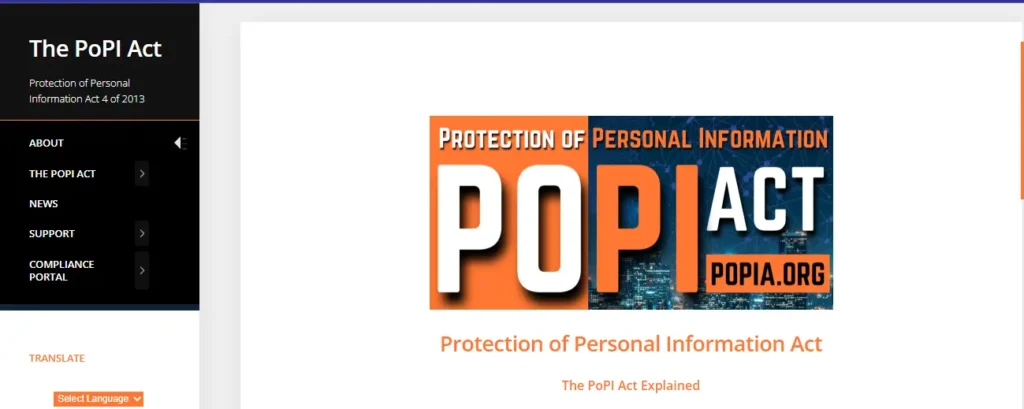
POPIA stands for the Protection of Personal Information Act. It is South Africa’s data privacy law. It came into full effect on 1 July 2021, and in 2026, the Information Regulator is actively enforcing it.
Here is what POPIA says in simple terms: if your business collects, stores, or processes personal information things like names, email addresses, phone numbers, ID numbers – you must protect that data.
Now think about your business email for a second. Your email does all three of those things. Every single day. Every time a client emails you, every quote you send, every newsletter you fire off – you are processing personal information. That means your email hosting provider matters more than you might think. Where their servers are located, how they secure your data, and how they handle potential breaches are all your legal responsibility. Not theirs. Yours.
A Common Myth About Small Businesses
I remember when Thandi told me, “I thought POPIA was for big corporates with legal teams, not for my little agency.” That is a very common myth. But the law applies whether you are a sole trader, a small PTY Ltd, or a nonprofit. If you receive an email from another human being, POPIA applies to you.
What POPIA Compliant Email Hosting South Africa Mean
The law does not name specific hosting providers. But it does set out clear conditions that your hosting must satisfy. Let me translate the legal speak into plain English.
Data Location and Security
Your provider must use encryption, access controls, and proper security protocols to protect personal information. If your email data leaves South Africa, you need a lawful reason – and the receiving country must have equivalent data protection laws.
Knowing Where Your Data Lives
You cannot comply with POPIA if you do not even know which country your emails are sitting in. Honestly, most business owners I talk to have no idea. That needs to change.
Breach Reporting
If your email is compromised, POPIA requires you to report it to the Information Regulator and affected parties without delay. That is a stressful process you want to avoid entirely.
The Information Officer Requirement
If your business processes personal data and email almost certainly means you do you need someone accountable for compliance. It can be you, but it has to be someone.
The bottom line is this: hosting your business email on a server inside South Africa, with strong security features, puts you in the safest possible position. It is not the only way, but it is the simplest and most straightforward.
Why International Email Hosting Creates POPIA Risk
This is where many South African businesses get caught out. And I mean many. Including people like Thandi.
If you use an international email provider such as Gmail for Business, Google Workspace, Microsoft 365, or any provider with servers outside South Africa – your client data is crossing the border every single time someone sends you an email. Every single time.
Understanding Section 72 of POPIA
POPIA section 72 governs cross-border transfers of personal information. It says you may only transfer personal data outside South Africa if:
- The recipient country has adequate data protection laws, or
- You have obtained the data subject’s consent, or
- The transfer is necessary for a contract
For most small businesses, getting client consent for every email is completely impractical. And countries like the United States do not automatically qualify as having adequate protection under South African law. In fact, the US has very different privacy standards.
The Realistic Risk for Small Businesses
Now, does this mean you will immediately be fined for using Gmail? No. Thousands of South African businesses use it. But it does mean you carry legal risk every single day and that risk grows as the Information Regulator increases enforcement activity.
Thandi was lucky. She had only a near-miss, not a full breach. But she realised that if her client’s data had been stolen, she would have to explain to the Regulator why her emails were sitting on a foreign server without proper justification. That was enough to scare her into making a change.
The safest move is simple: host your email on South African servers.
POPIA Compliant Email Hosting: Provider Comparison for 2026
Let me break down how the main South African business email providers stack up on POPIA compliance factors. I have kept this factual, but I will share my take too.
Provider Comparison Table
| Provider | Server Location | Rand Billing | SSL Included | Local Support | Storage | Price From |
|---|---|---|---|---|---|---|
| Truehost Workplace | Johannesburg (Teraco) | Yes | Yes | WhatsApp 24/7 | 10GB per mailbox | R8/month |
| xneelo | Johannesburg / Germany | Yes | Yes | Phone and chat | 5GB shared | R99/month |
| Afrihost | South Africa | Yes | Yes | 1GB basic | R84/month | |
| Google Workspace | USA (global) | No | Yes | No local support | 30GB | From R130/month |
| Microsoft 365 | USA / EU (global) | No | Yes | No local support | 50GB | From R150/month |
Note that Google Workspace and Microsoft 365 pricing varies with exchange rate. These are estimates at April 2026 rates.
The POPIA Standout
The provider that stands out for POPIA compliance in my view is Truehost Workplace.
Here is why I personally lean toward them after seeing what Thandi went through. Truehost hosts all email data at the Teraco data centre in Johannesburg the same facility used by South African banks and major corporations. Your emails, your client data, your documents none of it leaves the country. And at R8 per month per mailbox, it is the most affordable POPIA-friendly business email in South Africa right now.
Why Truehost Workplace Is a Smart POPIA Choice for SA Businesses
Let me give you several solid reasons, based on what actually matters day to day.
a) Your Data Stays in South Africa
Truehost runs its servers at Teraco Johannesburg. When a client emails you, that data travels a few kilometres – not across an ocean. It stays under South African law. No cross-border transfer risk. No section 72 headaches. After Thandi’s scare, she moved her whole agency over in one afternoon. This makes it popia compliant email hosting south africa.

b) Prices Are Fixed in Rands
This might sound small, but it is not. Google and Microsoft bill in US Dollars. When the rand weakens and we all know it does your email bill goes up automatically with no warning. Truehost bills in rands. R8 is R8. It will not change because of what happens in Washington or London. For a small business on a tight budget, that predictability is gold.
c) Security That Ticks the POPIA Box
Every Truehost Workplace plan includes SSL and TLS encryption on all email transmission, AI-driven spam filtering that blocks phishing and malicious links before they reach you, two-factor authentication on every account, and brute force detection to block unauthorised login attempts. These are not expensive add-ons. They come with every plan, even the R8 starter.
d) More Than Just Email
Truehost Workplace is not only an inbox. Every plan includes Docs, Sheets, and file storage – so you get a full digital office without paying extra. No need for a separate Google Drive or Dropbox subscription. That is a nice bonus when you are trying to keep tools simple and affordable.
e) Local Support When You Need It
This one matters more than you would think. If something goes wrong with your email at 10pm on a Sunday, you can WhatsApp Truehost directly. They respond in minutes. They speak your language. They understand the South African context, including POPIA requirements. Thandi tested this at 9pm on a Friday when she could not log in. She had a reply in 12 minutes.
Truehost Workplace Plans at a Glance
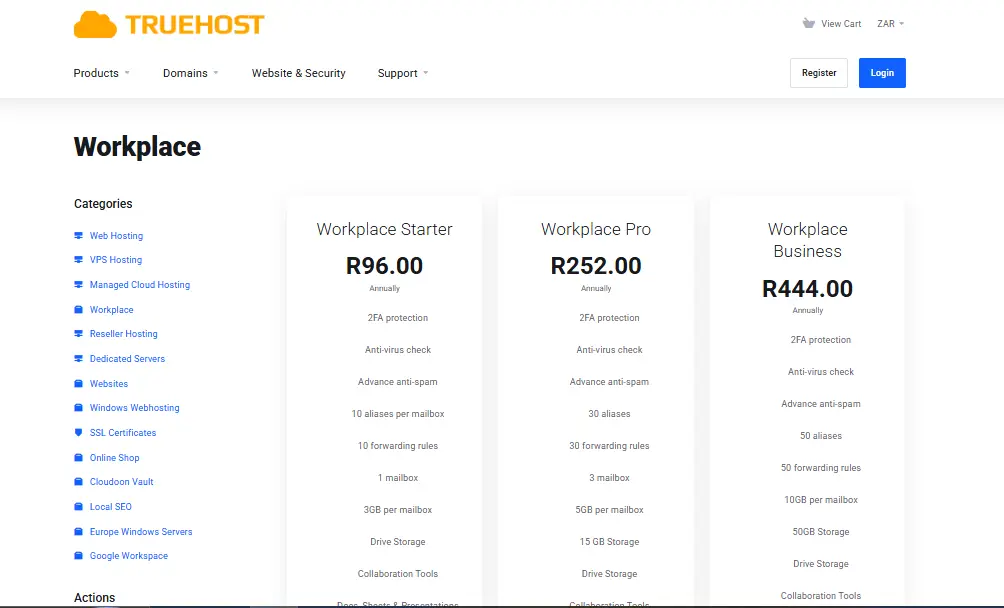
Here is a simple breakdown of the plans available.
i) Starter Plan
The Starter plan costs R8 per month and includes 10GB of storage per mailbox. It is best for freelancers and sole traders.
ii) Business Plan
The Business plan costs R21 per month and includes larger storage plus the full Workplace suite. It is best for small teams.
iii) Pro Plan
The Pro plan costs R37 per month and includes maximum storage plus advanced tools. It is best for growing businesses.
Prices shown are based on triennial billing. Monthly plans are available at higher rates.
All plans include free SSL, IMAP, POP3, and SMTP support, webmail access, AI spam filtering, two-factor authentication, Docs and Sheets, and 24/7 WhatsApp support.
A POPIA Compliance Checklist for Your Business Email
Grab a coffee and go through this checklist honestly. It will take you five minutes.
1) Data Location
- Do you know which country your email server is in?
- Is your email data hosted inside South Africa?
- If data leaves South Africa, do you have a lawful basis under POPIA section 72?
II) Security
- Does your email use SSL or TLS encryption?
- Is two-factor authentication enabled on all accounts?
- Do you have spam filtering and phishing protection?
- Does your provider offer intrusion detection?
III) Access Control
- Do only authorised employees have access to shared inboxes?
- Do you remove email access immediately when a staff member leaves?
- Do you use strong, unique passwords for all email accounts?
IV) Breach Readiness
- Does your provider notify you of security incidents promptly?
- Do you have a process for reporting breaches to the Information Regulator?
- Have you documented who your Information Officer is?
V) Vendor Due Diligence
- Have you reviewed your email provider’s privacy policy?
- Does your provider have a data processing agreement you can access?
- Is your provider billing you in rands? Stable cost means stable compliance budgeting.
If you ticked No on more than three of these items, your email setup carries POPIA risk right now. Do not panic, but do not ignore it either. The fastest fix is moving to a South African email host with local servers and built-in security. Thandi did it in a weekend.
What Happens If You Are Not POPIA Compliant?
The Information Regulator can impose fines of up to R10 million or 10 years imprisonment for serious violations. That sounds extreme, I know. For most small businesses, the more realistic risk is a compliance notice or a civil claim from a customer whose data was mishandled.
Enforcement Is No Longer Theoretical
But here is the thing: in 2026, enforcement is no longer theoretical. The Regulator has already issued enforcement notices against South African companies and more are expected as awareness grows. The cost of getting compliant can be as little as R8 per month. The cost of getting caught is far higher, both in money and reputation.
A Word of Honesty
I will be honest with you. I am not a lawyer. This is not legal advice. But after watching Thandi scramble to fix her setup while also managing client panic, I can tell you that being proactive is a thousand times better than being reactive.
Frequently Asked Questions
Is Gmail POPIA compliant for South African businesses?
Gmail and Google Workspace store data on servers outside South Africa, primarily in the United States and Europe. This creates cross-border transfer risk under POPIA section 72. While many businesses use it, it requires additional legal justification. Hosting with a local South African provider eliminates this risk entirely.
Do I need POPIA compliance if I am a small business?
Yes. POPIA applies to any business sole trader, PTY Ltd, or NGO that processes personal information. If you receive emails from clients, customers, or subscribers, POPIA applies to you.
What is the cheapest POPIA compliant email hosting in South Africa?
Truehost Workplace starts at R8 per month per mailbox. It includes local Johannesburg servers, SSL encryption, two-factor authentication, and AI spam filtering – everything you need to tick the POPIA compliance box at the lowest price available in South Africa.
Does my email provider need to have a data processing agreement?
Good practice under POPIA – and under its guidelines for operators is to have a written agreement with any third party that processes personal information on your behalf. Your email host qualifies as an operator. Truehost can provide documentation on request.
How do I move my existing email to a POPIA compliant host?
Truehost migrates your existing email accounts, including historical emails, for free. The process typically takes less than 24 hours with no downtime. You can reach the migration team via WhatsApp.
The Bottom Line
POPIA is not going away. Enforcement is ramping up in 2026, and saying “I did not know” is no longer a defence. I learned that from Thandi’s story, and I do not want you to learn it the hard way.
If your business email is hosted outside South Africa or on a platform without proper security you are carrying legal and financial risk every single day. The solution does not have to be expensive or complicated.
Truehost Workplace puts your email on South African servers, includes every security feature POPIA requires, and starts at R8 per month. That is less than a cup of coffee. And honestly, after seeing the peace of mind it gave Thandi, I think that is a pretty good deal.
Ready to get compliant today? Visit truehost.co.za to set up your POPIA-friendly business email in under 20 minutes. Your clients’ data and your future self will thank you.